




AI in Manufacturing: Cutting Scrap and Line Downtime
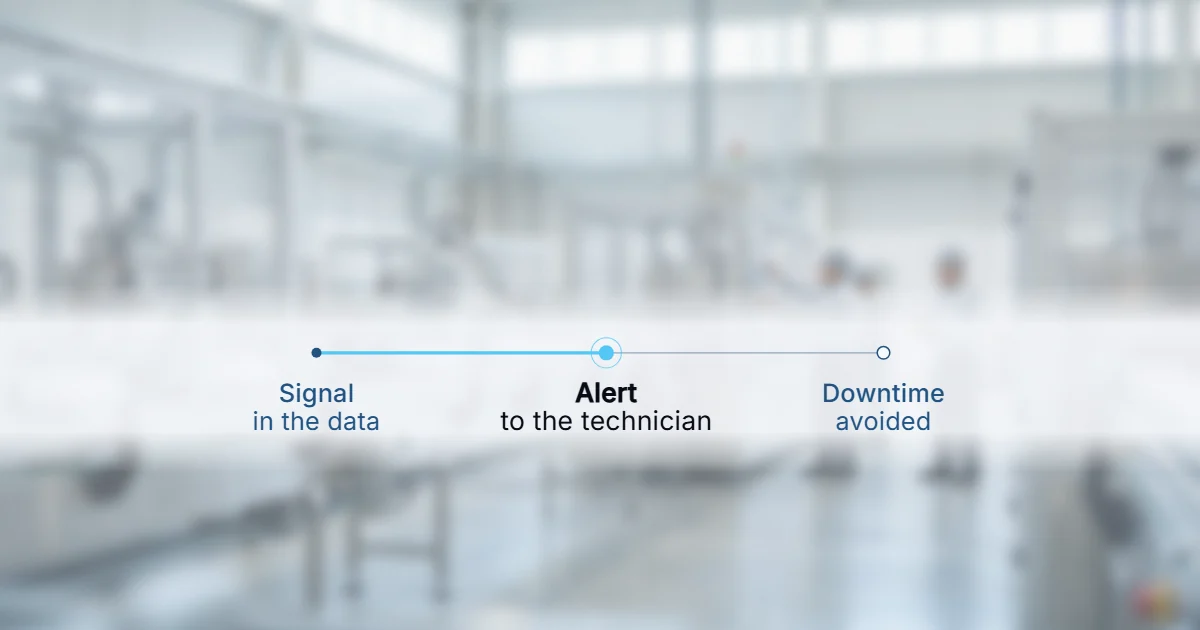
In short: AI in manufacturing cuts scrap and line downtime when an agent shortens the time between a signal that's already in your data and the person who can act on it: the technician before the failure, the operator at startup. With the plant's history it also looks ahead: it finds patterns, simulates scenarios and puts a price on each one before it happens. The result is measured in money per year against a baseline, and the first agent is in production in under 90 days on the systems you already have.
We don't come from a consulting firm. We come from a plant: Neurya was born inside an industrial group that has been operating for 53 years, and the first company we transformed with AI was our own. That's why this article goes straight to what leadership decides: what every hour of a stopped line costs, and how to get that money back.
What line downtime really costs
More than the plant report shows, because downtime and scrap are buried inside cost of production. They're compared against a standard that already has them built in, and hitting the budgeted scrap rate gets celebrated even when it's money sent to the dumpster or to rework. As long as it's discussed in OEE points (overall equipment effectiveness), nobody outside the plant makes a decision about that cost.
The True Cost of Downtime 2024 report from Siemens gives it a sense of scale:
- The world's 500 largest companies lose about $1.4 trillion a year to unplanned downtime, 11% of their revenue.
- A large plant loses 27 hours a month on average, more than a full day of production, spread across 25 stoppages.
- In consumer goods, the annual cost of downtime per plant has doubled since 2019, to just over $10 million, and it's the only sector where hours lost didn't go down.
- For a mid-sized manufacturer that supplies larger ones, an hour of downtime can reach $150,000 at the high end. The cost that hurts most comes later: the customer tracks how many orders arrive on time and in full, and the supplier that misses loses its place.
These figures come from a global survey run by a predictive maintenance vendor, so read them as scale. The number that matters is your line's, and how to calculate it is further down.
Your plant already has the data; it just doesn't arrive in time
87% of large manufacturers already collect data that could anticipate failures, according to the same report, and they still lose 27 hours a month. The signal is almost always there: vibration creeping up on a bearing, a temperature drifting out of range on the night shift. What breaks is the path from that signal to the person who can act: a screen nobody watches at 3 a.m., an email opened the next day, an alarm that goes off so often nobody responds anymore.
An AI agent closes that path. It reviews machine readings, checks them against the failure and maintenance history, and tells the technician on shift which asset, which reading, since when and what happened the last time that pattern showed up. With that, they decide in minutes whether to stop, adjust or keep running. When wear is coming, the agent drafts the work order so the repair happens during a planned stop, and the supervisor approves it. The agent never touches the machine's controls: the decision stays with your people.
There are two limits worth knowing from the start. Some stoppages give no warning: a part that breaks from an impact leaves no trace beforehand, and there the agent doesn't change the outcome. And if a maintenance order takes three days to collect two signatures, the alert arrives on time and the stoppage happens anyway. That's why the first things to measure are which stoppages had a signal and how long an order takes today to reach the technician.
From alerting to anticipating: an analyst that never sleeps
Using the plant's history, the agent finds the patterns that precede a stoppage, simulates what could happen and puts a price on each scenario before it happens. An example: it's 2 a.m. and filler 2 shows the same pattern that preceded 3 of the last 5 stoppages, vibration rising with a batch from one specific supplier. The agent works out both paths. Stopping now for 40 minutes to swap the part has a known cost. Running until shift change carries the risk of a 4-hour stoppage and of shipping your main customer's order short tomorrow. The supervisor decides with both numbers in front of them, in money.
The same analysis compares each line against the others, each shift against the rest and the plant against its industry benchmark, so leadership sees where the losses are and how large they are. That way the first investment goes to the line where the data shows the biggest loss.
Behind every recommendation, several frontier models from Anthropic, OpenAI and xAI check one another before anything reaches your people. If they don't agree, the recommendation comes out as an open question, with each model's reasoning, never as a certainty. That's how it works in our plant and in many others where it already runs.
Scrap is decided in the first minutes of startup
If your scrap rate swings a lot from shift to shift, it is almost always being decided at line startup and at changeover. Those are the minutes when the process isn't stable yet, and whatever comes off the line gets thrown out or reworked. Your best operator knows what to adjust first and which reading to watch; the shift that doesn't learns at the cost of material.
The agent compares the first readings of every startup against the startups that went well, for that product and that machine, and tells the operator at minute five that something is drifting. What your best shift knows becomes available to everyone, night shift included. That's how a plant takes on another shift or more volume without adding a supervisor per line: it grows without adding overhead.
The prerequisite is that the log exists. If stoppages are recorded today as «mechanical failure», with no cause or action, the first step is to agree on what gets recorded. On a messy process, AI only speeds up the mess.
How to take it to the board: money per year against day 0
With a baseline taken before the agent is connected, converted to money per year together with finance, and read by line and by shift. The monthly average hides what matters: if stoppages drop on the day shift and stay the same on the night shift, the total barely moves.
Annual cost of downtime = hours of unplanned downtime per year × what the line stops earning in one hour
Annual cost of scrap = units scrapped or reworked per year × what had already been invested in each one (material, energy and labor)
An illustrative example: a line that stops unexpectedly 8 hours a month and loses 60,000 pesos of output per hour loses 5.76 million pesos a year. If those stoppages drop to 6 hours a month, 1.44 million a year comes back. That's the number that goes to the leadership meeting.
The number can also say no. If stoppages that had a prior signal didn't drop within a quarter, the hold-up was in order approval, in spare parts or in stoppages that never give warning, and the same report shows it. The criteria for presenting it are in Recovered Revenue: The Metric Your CEO Signs Off On.
Three questions for your next production meeting
- What did downtime and scrap cost us last year on our most expensive line, in money and validated by finance? If the figure only exists as an OEE percentage, that's your first finding.
- What share of those stoppages had a prior signal in the data? That's the share an agent can reduce.
- How long does a maintenance order take today to reach the technician? If it's days, the hold-up is in approval, and an authorization rule fixes it before any technology does.
Before your next board meeting
We measured it in our own plant first, on our own Odoo: today 100% of receiving lines are checked against standard cost. That's the method we bring to your most expensive line.
If you already know which process you want to move, we go straight to the solution. If you're not sure where to start yet, consulting starts at 120 thousand pesos plus VAT. Either way, the first production agent arrives in under 90 days, on the systems you already have and measured against day 0.
Go deeper:
- An agent catching scrap before it happens, running: manufacturing and engineering demo
- Use cases on the plant floor: Manufacturing and engineering
- Why nothing can be proven without a baseline: Why AI Pilots Don't Reach Production
- Once the first process is in production: AI agent implementation
Frequently asked questions
Do we need to buy new machinery or sensors?
Not to start. You begin with the data the plant already records; where sensors are missing, cameras are often enough, as we show in manufacturing and engineering.
How soon do we see results?
The first agent is in production in under 90 days. The effect in money is read quarter by quarter against the baseline, because a single month of stoppages varies too much to draw conclusions.
What happens to my maintenance team?
They keep making the decisions. Their work shifts from reacting to failures to scheduling repairs in planned windows. What the agent flags, at what threshold and to whom is defined with them, as part of our method: an agent that sends twenty alerts a shift gets muted within a week.
Have a question about this for your company?
Leave it and we'll reply by email. No commitment.
Prefer to explore on your own? Take the self-assessment (5 min)