
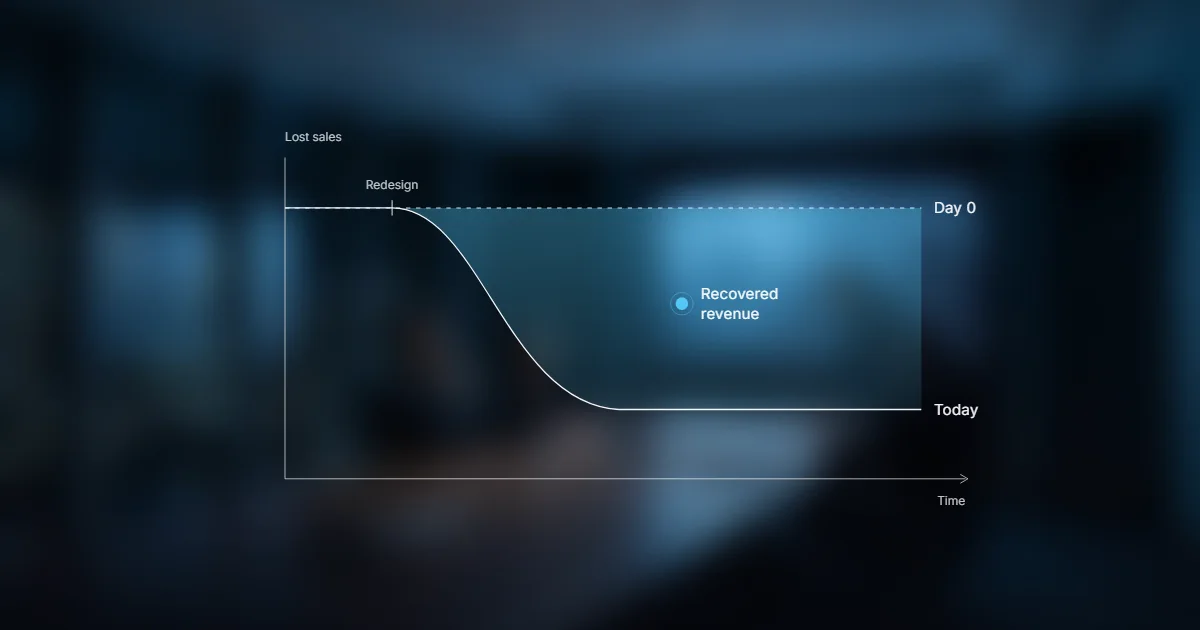
In short: Recovered revenue is the sales, collections and customers your company was losing to delays or errors, and stops losing once that process is redesigned to work with AI agents. To claim it, you need to know how much you were losing before you started; without that number, any figure is an estimate.
It's the first number a CEO can take to the board, because it shows up in margin, not in an hours report. It isn't the only one: growth that comes from taking market share from your competitors is measured separately. Here we explain how it's calculated, where to find it in reports you already have, and what to ask of a project before approving it.
A seven-minute read, with four things you can ask for on Monday.
Most AI reports that reach a CEO's desk talk about productivity: tasks resolved and work the team no longer does by hand. They're real numbers, but none of them can be pointed to on the income statement, and the CEO who receives them can't take them to the board as a return on investment.
Gartner surveyed 204 finance leaders in March 2026 and found that 45% of their AI investment leans toward productivity and only 20% toward better decision quality. Boards, the same study warns, put more weight on growth, better decisions and competitive advantage. Its recommendation: measure enterprise impact, not the number of pilots or hours saved.
Our read is that the gap persists even in projects that work. A project can meet the three conditions for reaching production (a business owner, a baseline and a redesigned process) and still show up with a number the board doesn't know where to put. What gets decided in the boardroom is which initiative to invest in, and comparing one initiative against another takes a return expressed in money. Recovered revenue is that translation, and it answers one concrete question: how much money that used to leak no longer does, and how do we know?
What recovered revenue is, and why it isn't a saving
Recovered revenue is money the business already had within reach and was losing because of how a process worked; a saving is a cost that's no longer incurred. The difference decides which line the money lands on, and how far it can grow.
The distinction looks obvious and gets lost in practice: many projects are approved on the promise of selling more or collecting sooner, then reported in hours freed up. When that happens, the board receives a number from a different category than the one it approved, and has no way to tell whether the investment delivered.
Recovered isn't the same as new. Recovered revenue comes from demand that already existed: the customer already asked for the quote, the invoice was already issued, the contract was already up for renewal. That's why it can be measured precisely, unlike a new sale, which is measured with a different yardstick because it also depends on the market, the season or the price.
How it's calculated. With data finance and sales already have: how many opportunities flow through the process in a period, what share was lost before the redesign and what share is lost now, and how much margin each one leaves. The difference between the two loss rates, multiplied by volume and by margin, is recovered revenue. It's counted in margin, not in total sales, because a sale rescued with a discount is worth less than the invoice says.
When a saving becomes recovered revenue. When the capacity it frees up is put to work exactly where money was leaking. If the team that stopped reconciling invoices by hand now calls every customer a month before renewal, and more of them renew, that time became revenue. If it isn't given any new work, it stays a saving and never reaches the margin.
The mistake that inflates the number. Counting the same money twice, once as a cost saving and again as recovered revenue. The math is done once, with finance.
Where to find the revenue you're losing today
Lost revenue doesn't show up as a loss on the income statement, but it almost always leaves a trail in reports the company already produces. Looking there, before you start, is what turns a hunch into a number.
- In the CRM: response time against win rate. Match how long each proposal took to go out with whether it was won or lost. If late proposals lose more often, you have your first leak with a figure attached.
- In accounts receivable: discounts granted to close out an account. Every credit note issued to get a late customer to finally pay is margin given away because collection was slow.
- In the customer base: renewals that never came. Look at which customers didn't renew last year, and how many had an open complaint or an incomplete order in the three months before.
- In the warehouse and in sales: orders that shipped incomplete. What the customer ordered and didn't get on time may end up bought somewhere else; in the system it only shows as a cancelled order.
Those trails give you the baseline this metric needs: how many opportunities enter the process in a period, how many are lost and at what point. Take it over a comparable period, same quarter and same customer mix, so seasonality isn't mistaken for results.
Measured or estimated: the difference the board does see
A defensible number states how it was obtained: measured against real decisions, or estimated from an equivalent process. Both kinds of figure are useful. What isn't useful is presenting them as if they were the same thing.
In the treasury case of Human Staff, a staffing services company, the system classifies 76.2% of bank transactions on its own, with 97.5% accuracy. Both figures are measured: they came from running the system against 1,043 transactions an accountant had already classified by hand, comparing them one by one. The time figures in the same case are labeled as estimates, because there was no quantitative baseline for the manual process.
In the tax case of Comex, where seven legal entities now review their e-invoices in a single inbox, the case says it plainly: no time savings are reported, because there was no baseline.
That's the discipline worth requiring before approval: every figure carries its label, so no one defends a projection as a result.
When recovered revenue is the right metric, and when it isn't
Recovered revenue is the right metric when the process touches a sale, a collection or a customer; when it doesn't, forcing it produces a made-up number. Not every AI project should be measured the same way, and demanding that is just another way of measuring badly.
Gartner warned CFOs in March 2026 to stop looking for a single ROI formula for AI and to treat it as a portfolio: productivity use cases, targeted process improvements and transformational bets, each with its own cost, timeline and risk. We agree. That's why each case commits to one business metric, and only one, chosen from the same family of four: recovered revenue, cycle time, cost per transaction and capacity gained without adding headcount.
The choice depends on where the process lands on the business map. If it touches the core (quoting, collections, renewals, fulfillment), the metric is recovered revenue, and the other three help explain it: a shorter cycle matters because the proposal arrives first, and a lower cost per transaction matters only if that margin isn't given away in discounts. If it's a support process, like the accounting close or a compliance review, the honest metric is cost per transaction or cycle time, and that's how it gets presented.
The same Gartner analysis adds a nuance worth keeping in mind: part of AI's value shows up first in better decisions and only later on the income statement. When that's the case, the report should say which metric moved today and by what date it's expected to show in the margin. What the CEO approves on recovered revenue are the projects that promise to touch revenue; those are the ones that owe the number.
What recovered revenue doesn't measure: the market that isn't yours yet
Recovered revenue measures your company against itself; the most valuable growth is outside, in the market that isn't yours yet. Your receivables, your collections and your customers' satisfaction show up on your income statement, but they compare your performance against your own past. With AI in production, three fronts open up that this comparison doesn't capture:
- Market share. Responding sooner and with a better proposal is how you win the sale your competitor takes today.
- Selling more to current customers. Understanding what each customer buys and needs lets you offer the next thing without going out to find new customers.
- New needs and new markets. A service that was impossible to sustain by hand can become something your customers didn't know they could ask for.
Recovered revenue comes first because it's measured with data you already have. The other three are measured with a different yardstick, market share and revenue per customer, and we cover them in detail in an upcoming article. That's the ground where a company gets ahead of its market.
What to do on Monday
- Ask finance for the value of one sale, collection or renewal lost last quarter because of response time. Just one, with a figure. It's your first piece of unrecovered revenue and the best candidate to measure.
- Ask for that process's baseline in two columns: measured and estimated. If everything lands in the second, you already know the project's first deliverable: filling in the measured column.
- Take the last AI report you received and underline every figure expressed in hours. Ask for each one to be translated into margin, cycle time or cost per transaction, or to explain which decision it improved. Hours alone don't go to the board.
- Before approving, ask what work the time the project frees up will go to. If nobody knows, what you'll get is a saving, not recovered revenue.
Before you approve the next project
If you've already found the process where revenue is leaking, an Agentic Discovery takes its baseline, turns it into a business case and separates, from day one, what will be measured from what will be estimated.
If you're still working out where to begin, the Getting-started guide covers in eight pages how to start with AI and agents, without technical jargon.
To go deeper:
- The cost side: How to grow without hiring more people
- Before it reaches the table: From the board seat: 4 questions before AI approval
- The three conditions for reaching production: Why AI pilots don't reach production
- Measured and estimated figures, case by case: see case studies
- The five moves, from diagnosis to the number: Neurya's method
Documented cases by industry available under a confidentiality agreement.
Frequently asked questions
What is recovered revenue in an AI project?
It's the margin or sales a business captures back because a process that was losing money to delays, errors or friction was redesigned and now works with AI agents. It's measured against what the process was losing before the project started. Without that comparison, the figure is an estimate, not a result.
How is recovered revenue different from a cost saving?
A saving reduces the expense line. Recovered revenue lifts margin because the business captures sales, collections or customers it used to lose. A saving only becomes revenue when the time it frees up is assigned to recovering something, and that decision is made when the project is approved, not afterward.
How do you measure the ROI of AI in a company?
For recovered revenue, with concrete math: the opportunities flowing through the process, times the difference between the day-0 loss rate and the current one, times the margin on each. That figure, minus what the project costs, is the return. Every input in the math should state whether it was measured or estimated.
Who should calculate recovered revenue: the company or the vendor?
The company: finance, together with the process owner. The vendor provides the system data and helps read it, but if it calculates the result of its own work, the board will take the figure with reservations, and rightly so. Whoever signs the number has to be able to defend it without the vendor in the room.