




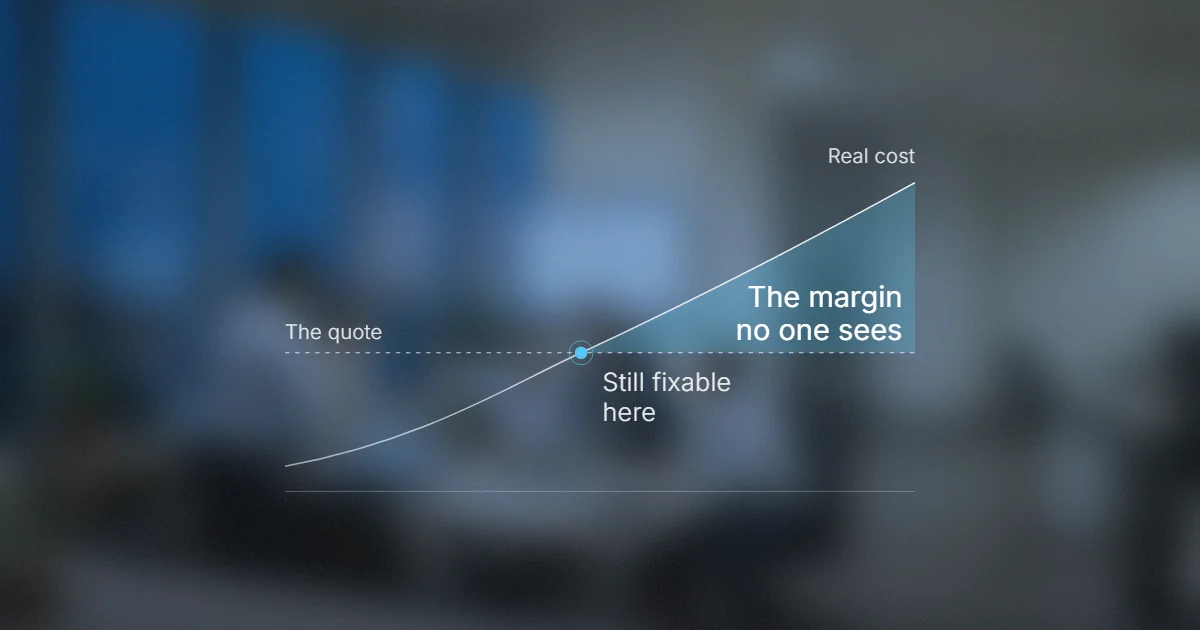
Automating Professional Services: The Margin No One Sees
In short: Automating processes at a professional services firm recovers the margin lost around billable work. There are three leaks: the change nobody quoted, the work that never made it to an invoice and the project cost you only learn at closeout. All three share one cause: the information arrives when it can no longer be billed.
This article is for whoever runs a law firm, an accounting firm, an agency or a consultancy that sells projects by scope or at a fixed fee, and sees the team stretched while margin slips. At Neurya we help you know what a project costs before you quote it, not after you've closed it.
Being busy doesn't tell you what price you sold that time at. A firm can keep its people billing all year and lose money on every project, because the utilization report measures how much work was done, not how much was charged for it. When you learn a project's real cost at closeout, there is nothing left to decide, only a result to explain at the leadership meeting. That gap has no line of its own on the income statement. So nobody adds it up.
This isn't only a Mexican problem. According to SPI Research's 2026 Professional Services Maturity Benchmark, published with Deltek, billable utilization at professional services firms fell to 66.4% in 2025, from 73.2% in 2021: its lowest point in nearly two decades. In the same study, industry EBITDA came in at 9.9%, against the 15% SPI considers the norm. It is a global measure, and we cite it for the pattern it shows: the time that gets paid for and never billed keeps growing, and margin absorbs it.
Why a fully booked team doesn't guarantee margin
Because utilization measures how much your people worked, not what that work was sold for. On a fixed-fee project, every week of work that wasn't in the proposal comes straight out of margin. In the report it looks like good news: everyone was busy and every hour was logged against a client.
Our view: in professional services, the metric most often reviewed in leadership meetings is the one that warns you least. The one that does warn you is real cost against the quote, by project, while the project is still open. When it isn't at hand, it's because it lives scattered across timesheets, the proposal and email threads with the client, and nobody pulls it together while the project runs.
The logic changes if you bill by the hour with no cap. There, scope that grows bills itself, and the leak is the work that was done and never logged.
The three margin leaks at a professional services firm
Margin goes into the small change nobody quoted, the work that never reached an invoice and the cost you only learned at closeout.
- The small change nobody quoted. The client asked for one change on a call, then another by email. The project grew and the proposal stayed the same. Nobody decided it: it piled up, and by the time someone notices, it looks like part of the original scope.
- The work that never reached an invoice. The extra meeting, the last-minute review, the partner's call to calm the client down. It was done and it cost money. If you bill by the hour, nobody logged it; if you bill by project, nobody compared it to the quote.
- The cost you learned at closeout. You find out what the project cost once it has been delivered and paid for. By then the number is only good for quoting the next one better, and only if someone stores it where the person quoting can see it.
Where each one starts and when you find out:
- The small change nobody quoted. It starts on a call or in an email from the client. Today you find out at closeout, when it already looks like original scope; with an AI agent, when the request comes in, because it's checked against the written scope.
- The work that never reached an invoice. It starts in the extra meeting or the last-minute review. Today you find out at invoicing, if someone notices; with an AI agent, that same week, because work done is compared against the quote.
- The cost you learned at closeout. It starts with nobody pulling the data together while the project runs. Today you find out once the project is delivered and paid for; with an AI agent, midway and phase by phase, while it can still be fixed.
All three have the same root, and it isn't lack of effort: you find out what it cost you when you can no longer bill for it. That is why adding another project coordinator won't close the gap if they work from the same report: they show up to the same meeting, with the same number, on the same day.
To put a number on yours, take a project you've already closed and run this calculation:
Margin that leaked (points) = (real cost − quoted cost) ÷ price billed × 100
Example: you quoted a project at $500,000 with an estimated cost of $350,000, expecting a 30% margin. If it cost $410,000 at closeout, 12 points leaked and the real margin was 18%. The first two leaks explain where that $60,000 came from. The third explains why you found out when you could no longer bill for it.
What to automate first: the quote, not the delivery
The quote, because that is where the margin on everything that follows gets set. A badly quoted project isn't rescued by flawless delivery. You just lose less.
When the person quoting estimates from experience and from the proposal for a similar project, one number is missing: what that project actually cost, because it was never stored next to the proposal. That is where an AI agent comes in: it reviews the projects you've already closed, compares what was quoted against what they cost and shows the person quoting which phases ran over and why. That person still sets the price, now with the history in front of them.
The proposal also goes out with scope written as line items you can check against: what's included, what isn't and how many rounds of changes. Every new client request is then measured against a document, not against someone's memory of the kickoff call. It appears as a use case on our business services page: the proposal or contract is built from the client data already in the CRM and left ready for someone to approve.
The prerequisite is having the real cost of past projects. If it doesn't exist today, the first job isn't AI: it's starting to record it by project and by phase.
How to know what a project costs while it's still running
By comparing work done against the quote every week, phase by phase, and alerting the project owner as soon as they drift apart. Midway through a project you can still renegotiate scope, move someone to another team or pause a phase. At closeout, all you can do is explain.
The agent pulls together what already exists: time records, deliverables and the emails where the client asked for something new. When a phase runs over the quote, it tells the project lead by how much and why; for example, two requests by email with no change order. The lead decides whether to renegotiate, absorb it as an investment in the account or adjust the team. The decision is recorded, and at closeout you know how much margin was given away on purpose and how much slipped without anyone deciding.
We applied a similar principle at a notary office, a real project we describe anonymously. Documents for each transaction arrived by email, courier, online portals and in person, and a mismatch between an ID and the deed was caught late. Today every file shows its stage, its owner and, when a third party is holding it up, who and since when. No file moves forward with data that doesn't match. The error is caught while it is still cheap to fix, which is exactly what a project running over its quote is missing.
Capacity freed up versus capacity billed
Freed-up capacity only counts once it turns into billed work: one more project, a new account or a scope change that now gets invoiced. An hour freed up that nobody sells is still a cost.
In professional services it's tempting to report results in hours, because the whole business runs on hours. The numbers worth taking to the leadership meeting are three others: margin per project against the quote, revenue per billable person and how many scope changes were billed in the quarter. It's the same logic as recovered revenue: money that comes back, not time that's freed up.
The limit case is taking on the next account without adding the team it has historically required. That's where you see whether capacity turned into sales. If there's no demand for that capacity, the conversation is no longer about processes: it's commercial, and it's worth having before you automate.
What to do on Monday
- Take last quarter's three largest projects and compare their real cost against the quote, using the formula above. If you can't put that number together in an afternoon, that's your first finding.
- Note the week you learned that number. If it was at closeout, the leak is in tracking, not in delivery.
- Count how many client requests came in by email or phone with no change order. Each one is scope given away without anyone deciding to.
- Set one new rule: no scope change moves forward without a number. It can be zero, if you decide to absorb it; what it can't be is unpriced.
Before you quote the next project
In Agentic Discovery we get inside your business, put a number on how much margin your projects lose and in which phase, and have the first process running in about 90 days, with its impact measured. If the business case doesn't justify it, you keep the roadmap and decide with numbers.
Go deeper:
- Use cases in professional services: Business services
- How we work, phase by phase: Method
- How it's measured in money: Recovered Revenue: The Metric Your CEO Signs Off On
Frequently asked questions
Which processes should a law firm or an agency automate?
Beyond the quote and per-project cost tracking, the criteria for choosing any other process are in What to Automate First with AI.
Does this apply to a firm with fewer than 50 people?
The problem is the same: with few projects a year, each one that runs over its quote weighs more on the result. What changes is where to start: the rule that no scope change moves forward without a number needs no technology.
How much does it cost to implement AI agents at a professional services firm?
It depends on scope. Before asking for a figure, find out how much margin you lost last year on projects that closed over their quote: that number tells you how much it's worth investing to close the gap.
Have a question about this for your company?
Leave it and we'll reply by email. No commitment.
Prefer to explore on your own? Take the self-assessment (5 min)