




What to Automate First in Your Plant
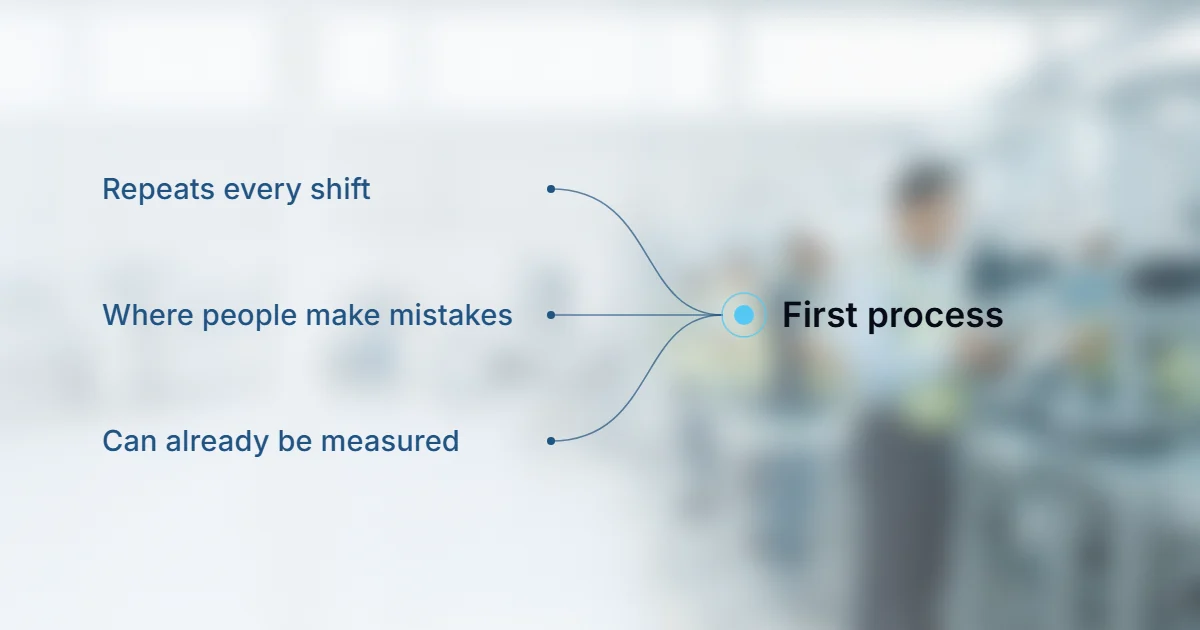
In short: In a plant, the first process worth automating is the one that meets three conditions at once: it repeats every shift, it's where your people make the most mistakes, and its cost can already be measured. If one is missing, the project stalls as a pilot. If all three are there, the first agent goes into production in under 90 days and its result is measured in money.
We write this from the plant floor, not from a boardroom. Neurya comes from an industrial group that has been operating for 53 years, and before bringing AI to anyone else's company, we put it to work in our own.
In September, manufacturing output in Mexico fell 1.7% from August, according to INEGI's Monthly Industrial Activity Indicator, published November 11; compared with September 2025 it grew just 0.5%. With demand like that, a plant's margin depends less on selling more and more on how much it produces with the team it already has. The easy answer is to add a shift. We read it differently: before you grow by hiring more people, recover the capacity that's currently going into fixing mistakes.
In what to automate first we laid out the general criteria, using office processes like quoting and collections. On the plant floor those filters work differently, because a mistake multiplies across shifts and parts, and the answer is already in a document your supervisor fills out every day: the shift report. Here the criteria fit in three questions.
What a mistake that repeats every shift really costs
More than it looks, because it's paid in pieces so small that no report adds them up. A wrong material delivery that stops the line for a few minutes, a part that has to be run again, an entry someone corrects the next day, a lot released late because nobody could find the latest drawing revision. Each one gets solved within the shift and never shows up on its own in the income statement: it dissolves into cost of production.
An illustrative example: if a wrong material delivery stops the line for 20 minutes twice a week, and that line loses 30 thousand pesos of output per hour, that's 20 thousand pesos a week. Over 50 weeks, that's one million pesos a year, from a single mistake on a single line. It's capacity the plant has already paid for and isn't using.
Recovering it doesn't mean cutting anyone. In a Gartner survey of 1,303 senior functional leaders, published November 4, 23% reported a headcount reduction due to AI and 17% reported an increase. Gartner's warning is that the time AI frees up doesn't turn into money on its own: someone has to decide where it goes. In a plant, the answer is the line: a supervisor who no longer copies sheets is on the floor when the shift starts.
First question: what gets done every shift, many times over?
The first candidate is a process your people repeat every shift, several times, because that's where any improvement multiplies. On the plant floor the usual ones are the end-of-shift production report, material delivery to the line, first-piece approval and the reject log. Something done once a month, like the physical inventory count or the cost close, can hurt a lot, but it doesn't go first: it improves twelve times a year, not hundreds.
That's the difference from the office. In a quote, one mistake costs one sale. In a plant, the same delivery mistake repeats across all three shifts and at every model changeover until someone changes the process. That's why, on the floor, how often a process repeats matters more than how good it looks in the demo.
Second question: where do your people make the most mistakes?
When the same mistake shows up across shifts and with different people, it isn't carelessness: it's the process, which forces people to enter data by hand, remember a part number or look up the same figure in three places. The operator delivering from Monday's printed list doesn't know engineering changed the part number on Tuesday. The supervisor closing out the shift copies sheets into Excel in a hurry because the next crew has already arrived. The mistake comes from how the process is built.
That's where an AI agent does help: it gets the data ready for whoever needs it, when they need it. It checks the production order against the current bill of materials, flags anything that doesn't match and leaves the end-of-shift report ready for review. The operator or supervisor still makes the call; what changes is that they're no longer deciding on the wrong data.
Finding those points doesn't take a study. Last month's rework notes, quality rejects and customer complaints already show where people make mistakes. If a process shows up on all three lists, you have a candidate.
Third question: do you already know what it costs today?
Measurable means today's number exists, not that the process is easy to connect. They're different things. A process can have sensors on every machine and nobody knows what each mistake costs; another can live on paper and have its cost well documented in the rework notes. Without that number there's no way to prove the result, or to ask for the next phase.
If the number doesn't exist, the process isn't ruled out: it gets logged before anyone touches it. One sheet per shift is enough, with two columns, how many times it happened and what it cost to fix, filled out by the supervisor for a few weeks. With that log, the cost stops being a feeling on the shift and becomes a number finance can validate.
What a process that passes all three looks like
You recognize it because the supervisor can describe it in one sentence and its cost is already written down somewhere. An illustrative example: in an auto parts plant, the supervisor on each shift spends the last half hour typing production, reject and downtime sheets into Excel. It happens on all three shifts, every day. Entry errors surface the next day, after planning has already scheduled on bad data. And the cost exists: the credit notes for incomplete shipments that came out of that schedule.
It passes all three. The agent builds the end-of-shift report from what your systems already record, flags anything that doesn't match the production order and leaves it for the supervisor to review and sign. Planning gets the previous shift's data, validated, before scheduling the next one. The decision still belongs to the supervisor.
For that decision to be real, the report has to reach them with time to review it before the shift change, not at the last minute. As Luis González y González wrote in his El Financiero column on November 13, «a one-click approval, without reading, doesn't count as supervision» (our translation). The same holds in a plant: a signature given without reading lets the same entry error through, now with a sign-off.
Compare it with a process that passes two. A part number change nobody tells the warehouse about repeats and causes mistakes, but if nobody knows what each wrong delivery costs, it doesn't go first yet. First you log its cost for a few weeks, and then it competes.
When this test doesn't apply
There are two cases where the three questions point to the wrong place. The first: when what's holding back output is the machine, not the process. If your bottleneck is a press already running at its limit, or equipment that stops without warning, freeing up the supervisor's time won't produce a single extra part. There the path is different, and we cover it in AI in manufacturing: cutting scrap and line downtime.
The second: when the mistake starts outside your plant. If the rework comes from material that arrives out of spec, automating the process where the mistake shows up only catches it faster. The three questions then go to receiving and supplier quality, which is where the cost begins.
What to do on Monday
- Ask each supervisor for a list of what their shift does every day, and how many times. One sheet per shift is enough; differences between shifts are a finding too.
- Mark on that list where there was rework, rejects or customer complaints last month. Use the quality records, not the team's memory.
- For the marked processes, ask whether there's a number today for what they cost. If there isn't, start logging it this week.
- Bring the process that meets all three to your next meeting, with its cost in pesos per year. If none meets all three yet, bring the closest one and what it's missing.
Before you choose your first process
We applied this test at home first. On our own Odoo, the purchasing review runs every week and every receipt is checked line by line against standard cost.
If your plant has already identified the process that passes all three questions, we go straight to the solution. If it isn't clear yet, consulting starts at 120 thousand pesos plus VAT. Either path ends with an agent in production in under 90 days.
Go deeper:
- The general criteria, with office processes: What to Automate First with AI
- When the bottleneck is the machine: AI in Manufacturing: Cutting Scrap and Line Downtime
- What agents do inside a plant: Manufacturing and engineering
- From the chosen process to the first agent: Agentic Discovery
Frequently asked questions
Do I need sensors or an MES (manufacturing execution system) to start?
No. You start with what your plant already records, even if it's on paper or in Excel. If a piece of data is missing, it gets logged first; buying a new system isn't a requirement for the first agent.
What happens to the supervisor or operator who does that process today?
They stay in charge: the agent gets the data ready and the person reviews, corrects and signs. What they stop doing is copying and searching, so they spend more time on the floor, which is where a supervisor prevents the next mistake.
How long until we see the first result?
On a single process, the first agent is working in production in under 90 days. The effect is read in money against today's number, shift by shift, to separate the result from a month that simply went well.
Have a question about this for your company?
Leave it and we'll reply by email. No commitment.
Prefer to explore on your own? Take the self-assessment (5 min)