
In short: AI adoption with employees happens when each person sees the system make their work better, and breaks down when nobody tells them which decisions change, who makes them now and what number they are measured against. It isn't fear of technology: it's uncertainty. That is why adoption is designed before implementation, with the people who will work alongside the system.
Picture an agent already in production capturing and validating your customers' orders. If the team doesn't trust it, someone keeps the same log in a spreadsheet “just in case,” someone else rechecks by hand what the system already validated, and every question goes up to a manager instead of being settled at the desk. The company pays for the system, keeps paying for the structure it was meant to free, and the savings or revenue that justified the investment never show up in the results.
Roles are already changing. In a Gartner survey of 110 chief HR officers, published in March 2026, 78% agree that workflows and roles must change to get full value from AI investments, and just over half have already redesigned or redefined roles because of AI in the past year. The question for leadership is not whether its people's work will change, but whether they hear it from leadership or work it out on their own.
In Why AI pilots don't reach production we covered the conditions a project needs. This article is about the people who will work in the redesigned process, and what they need to know before the system goes live.
What your team is really afraid of
Your team is not afraid of the tool: it is afraid of not knowing what happens to its jobs, its judgment and the way its work will be evaluated. Nobody on the floor asks whether the model is good. They ask whether their shift survives, whether what they know still counts, and whether tomorrow they will be measured by a yardstick they have never seen. When leadership announces an AI project without answering that, everyone runs their own numbers, quietly.
The fear is not baseless. In another Gartner survey, of 350 executives at companies with revenue above USD 1 billion, about 80% of those piloting or deploying autonomous capabilities report workforce reductions. The same study found those cuts do not explain returns: reduction rates were nearly identical among companies with stronger results and those with modest gains or losses.
Our view: the return on an AI project doesn't come from cutting people. It comes from what the team does with the capacity the system frees up: quoting faster, collecting on time, serving existing customers better (we explain it in How to grow without hiring more people). That is what your people need to hear from leadership, before any rumor does. And if a role is going to change, say that too: staying quiet doesn't avoid the conversation, it only delays it until the team has drawn its own conclusions.
Why adoption comes before implementation
If people meet the system the day it goes live, you are already late. In our method, adopting with your people is movement 03, and it comes before implementation, movement 04, by design: first you decide with the team how it will work, then the system goes into production.
Training at the end teaches people which screens to use. It doesn't tell them what they stop doing or what they now decide, which is what anyone needs to know before letting go of the old process. Without that answer, they keep it running in parallel, just in case.
Adopting with your people (03) and following through until the number is met (05) are the two movements where other firms' AI projects die, and the two almost nobody prices in. At Neurya they are not an add-on: they are part of the method.
The four things each person needs to know before day one
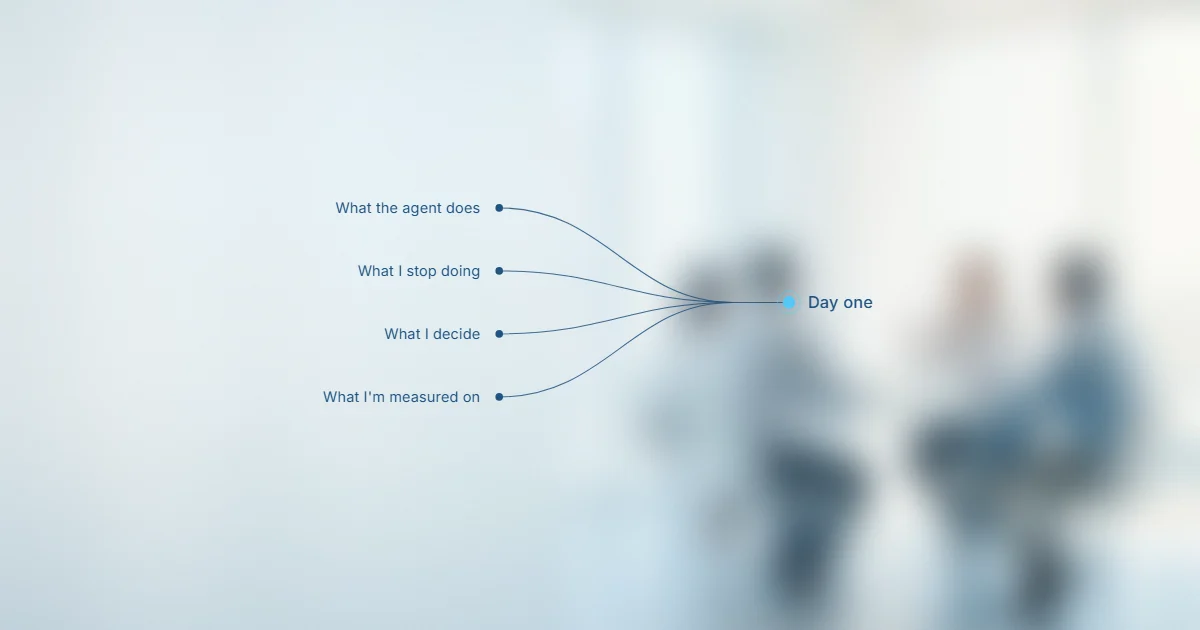
Everyone who touches the process needs four answers in writing before the system goes live:
- What the agent does: the tasks that move to the system, one by one, and where each action is logged: what it did, with what information and why.
- What they stop doing: what is no longer theirs, so they don't keep doing it in parallel.
- What they now decide: the judgment that is now theirs and that the system doesn't touch.
- What number their work is measured against: how they will be evaluated from day one.
The first three describe the new role. You can see it in the Coca-Cola case, with nine recruiting processes in production since November 2025: the system opens the requisition, screens applicants, interviews them by phone, scores them and walks the candidate through to signing. Recruiters stopped scheduling, transcribing and chasing documents. They decide who gets hired.
The fourth is the one most often skipped, and the one that matters most. If the person who now decides is still measured on volume captured, they will keep capturing. That is why we say the same thing on every project: “We don't report hours saved. We report recovered revenue, cycle time, cost per transaction and capacity gained without adding structure, against a baseline taken before work begins and reviewed with leadership at every phase.” Each person's number follows from there.
From user to the person who calibrates the process
The third answer, what they now decide, is the one that lowers uncertainty the most: whoever calibrates the system stops being the person AI takes work from and becomes the person who corrects it. Whoever works the redesigned process is best placed to calibrate it, and that role is assigned during design, not handed over with a manual at the end. The agent will get the unusual cases wrong: the customer with special terms, the document that arrives incomplete, the exception nobody wrote down. Someone with years in the role spots those cases before anyone else.
Think of it as a kitchen: the cook is the same, the knives and the system they work with change, and that decides how many dishes go out and how good they are. But the recipe lives with the cook, not the knife. Poteto, an engineer who ships thousands of software changes a month by directing agents, says it in a conversation with Matt Pocock: the bottleneck is no longer the agent, it's whether the person can state clearly what they want to achieve.
To calibrate, people have to see what the system did: every action the agent takes is logged, with the information it used and the reason why. Anything that moves money or touches a customer goes through a person before it runs; the rest is reviewed by sampling. That is *human in the loop*, a person inside the decision cycle, and without it nobody lets go of the old process.
If their job is to flag the exception and explain why, the system improves every week and the person gains a role they didn't have before. If their job is only to use it, the exception gets fixed by hand, off the system, and nobody learns the system failed.
The limit: calibrating takes time, and that time has to come out of the workload the agent freed up. If the workload didn't drop, nobody will calibrate anything, and that is worth checking before blaming adoption.
Signs that adoption didn't happen
When uncertainty isn't resolved, it doesn't show up as a complaint: it shows up as an old process that is still alive. The parallel spreadsheet, the double entry or the escalations that never used to exist are how a team protects itself from what nobody explained. Each one is structure that was never freed, and the company keeps paying for it.
There is a harder sign to spot. In the same change management analysis, Gartner warns that people may “perform” change without truly adopting it, because taking part opens doors to opportunities. The system shows up in the usage report while the real work happens somewhere else.
That is why active-user counts are not enough. The first test is the old process: if nobody feeds it or checks it anymore, the system replaced it. The deciding test is value: adoption is directly proportional to the value a person or a business unit creates with the system, with the same people. If that value didn't grow, adoption didn't happen, whatever the usage report says.
What leadership has to do
Uncertainty opens or closes with the first message, and that message comes from the owner, not from IT: what changes, why, and what doesn't change. IT can explain how the tool works. Only leadership can say what the freed capacity is for and what happens to people, which is what the team actually wants to hear.
What stays the same matters as much as what changes: the customers each person keeps serving, the judgment that is still valued, the way performance is still assessed. Without that message, the team fills the gap with the worst case.
What leadership should not do is promise what it doesn't control. “Nobody is going to lose their job,” said to reassure, falls apart with the first reassignment. It works better to say what is known today and on what date the rest will be known.
What to do on Monday
- Pick the process you will redesign first and list everyone who touches it, by name and role. If you can't make the list, you don't yet know whose work is changing.
- Write the four answers for each person: what the agent does, what they stop doing, what they now decide and what number they are measured against. Wherever you have no answer is the uncertainty your team already feels.
- Choose who on the team will calibrate the redesigned process, not just use it. Make it someone who knows the exceptions by heart.
- Prepare leadership's message before anyone talks about tools: what changes, why, and what doesn't. If it doesn't fit on one page, it isn't decided yet.
Before you switch on the first agent
An Agentic Discovery starts with the process and the people who work it: what changes in each role, before any system is proposed. You come out with a business case and a first agent in production, with the team that will use it prepared from the design stage.
Go deeper:
- What a project needs: Why AI pilots don't reach production
- Phase-by-phase transformation, with your people: Agentic Transformation
- What it looks like in production: Case studies
- Building judgment in your leadership team: Academy
Documented cases by industry available under a confidentiality agreement.
Frequently asked questions
What if the team keeps resisting after you explain the change?
Check whether you explained the new process or only the intention to use AI. If the four answers are already in writing and resistance persists, listen to the reason: sometimes the redesign has a gap only the person doing the work can see.
Does the whole team need AI training?
Not at first. Start with the people who touch the process being redesigned, with the answers for their role rather than a general course. Leadership training is a separate track, in the [Academy](/solucion-academia/).
Who delivers the message if the owner isn't involved day to day?
The owner delivers the first one, even in a short meeting. After that, the director of the area that changes answers the day-to-day questions, using the same four answers in writing.